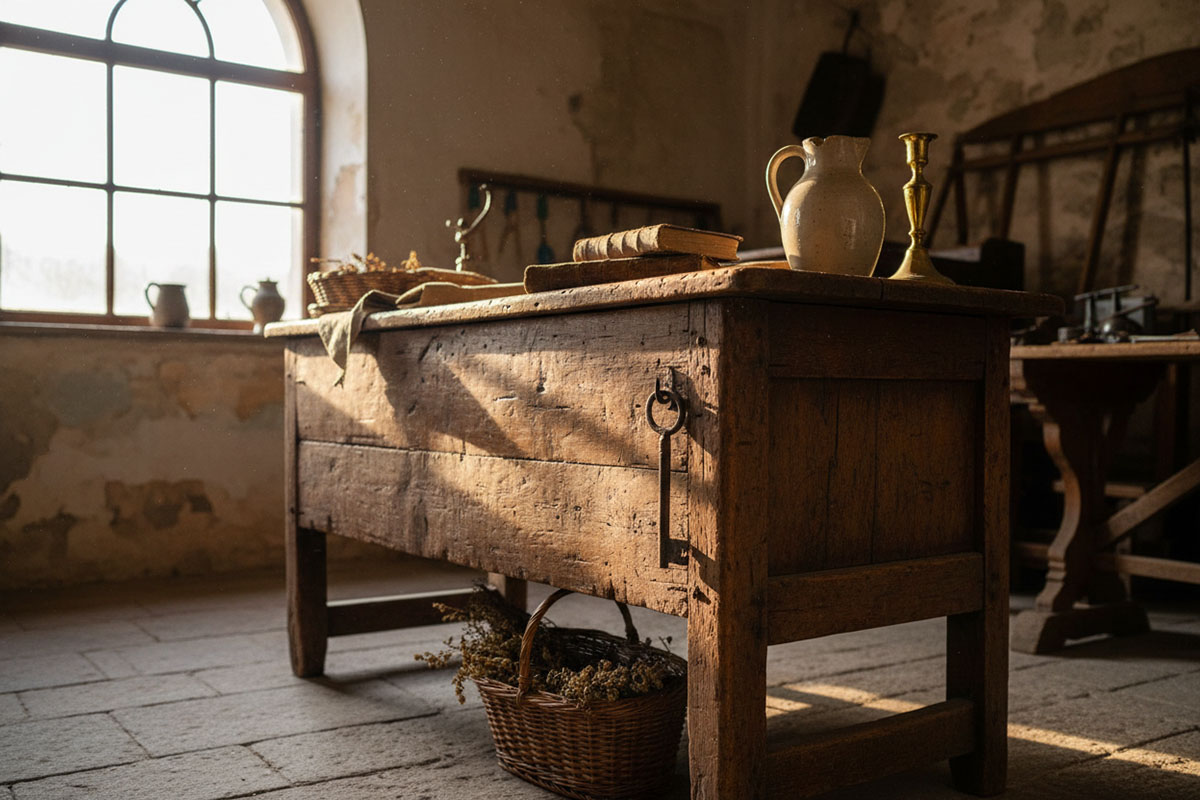
The sideboard is a traditional piece of furniture of Italian origin, whose history dates back to at least the 15th century. Characterised by a rustic and functional design, the sideboard was typically devoid of complex ornamentation and was ideal for placement in the kitchen, where it played an essential role in food preparation.
Its structure included a work surface, used for kneading bread, and a storage compartment, often barrel-shaped, for storing flour and other foodstuffs. This compartment was sometimes called a “fariniera” (flour bin), and in some Italian regions the cupboard itself was known by this name. The base of the sideboard was similar in shape to a small cupboard, equipped with doors or drawers to increase storage space.
Until the 17th century, only a few social classes owned a bread bin, as many people, such as peasants, did not have the right to grind grain or knead bread. The sideboard, therefore, was not just a piece of furniture, but also a symbol of freedom and social status.
Over time, different variations of sideboards emerged, including those known as ‘barrel-shaped’, ‘chest-shaped’ and ‘humpback-shaped’, which differed in their structural characteristics but all retained their function of providing support in the daily life of Italian families.